A business needs to be able to rely on its IT. Employees need access to their applications and information, business processes need to keep running, and customers need to be able to count on the service they are used to. That seems self-evident as long as everything is working well.
But that reliability does not happen by itself. It is the result of an IT environment that is carefully configured, actively managed, properly secured and adapted as the organisation evolves.
Business continuity is often associated with disasters, backups and recovery plans. These are important, but they are only part of the story. The greatest contribution of good IT management lies in preventing problems day to day that could disrupt business operations.
Business continuity does not begin when IT fails. It begins with the way IT is managed every day.
Strength comes from coordination
A modern IT environment consists of many components. Networks, servers, cloud services, workstations, mobile devices, business applications and security measures all need to function reliably.
But components that work well individually do not automatically make a reliable IT environment.
For example, an employee may have a well-secured laptop and a stable internet connection, yet be unable to work because a business application is unavailable. A server may run without problems, while a change to access rights prevents employees from accessing important information. And an application may be technically available, while an integration with another system no longer works.
Good IT management therefore needs to look beyond the performance of individual systems. It requires an understanding of their interdependencies and of the business processes these systems support.
The focus is on the reliability of the IT environment as a whole, rather than the availability of a single system.
Preventing problems before they affect business operations
Many IT problems do not arise suddenly. They are preceded by warning signs: recurring error messages, declining performance, capacity issues, ageing equipment or changes that do not fit well with the existing environment.
Proactive management and monitoring can identify such signs in good time. This makes it possible to take action before employees are actually affected.
Preventive management, however, involves more than technical monitoring. It also includes maintaining systems, managing vulnerabilities, checking configurations and assessing the impact of changes.
A well-managed IT environment is consequently more stable. Problems are also less often passed on to employees, who would otherwise have to find their own workarounds or interrupt their work.
The aim is not to resolve as many incidents as possible, but to prevent them from occurring.
Security also protects continuity
IT security is often seen as a separate subject, focused on preventing cyberattacks and protecting information. But security is also an essential part of business continuity.
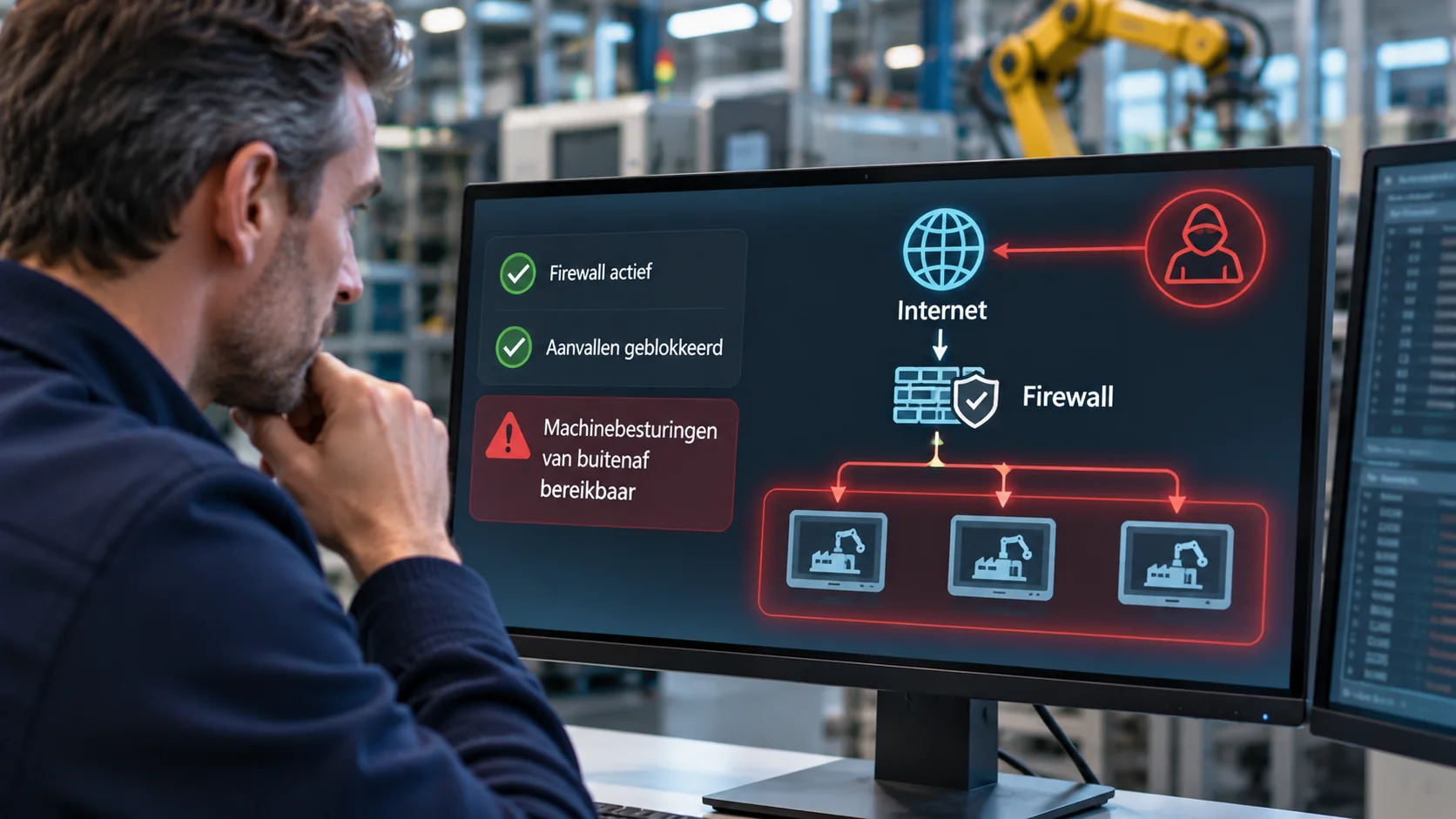
A ransomware attack can bring production processes to a halt. Misuse of a user account can compromise business data. Inadequately secured remote access can give an attacker access to systems the organisation depends on.
Security measures should therefore be integrated into routine IT management.
Identity and access
— Employees and suppliers receive only the access they need, with appropriate checks and security.Workstations and devices
— Computers, laptops, mobile phones and tablets are configured and managed securely, wherever they are used.Networks and infrastructure
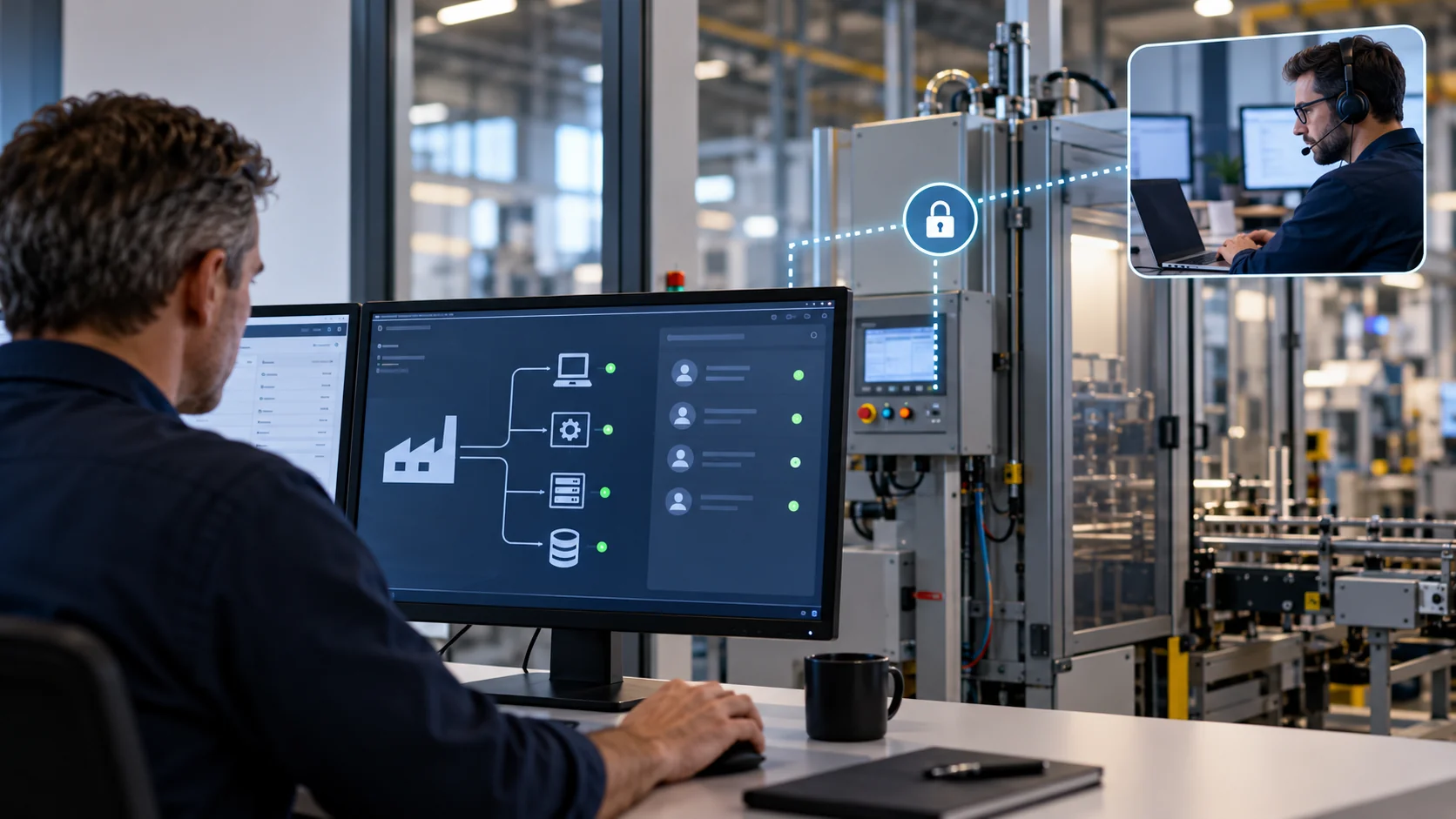
— Segmentation, secure connections and a controlled configuration limit vulnerabilities and the potential impact of incidents.Vulnerabilities and changes
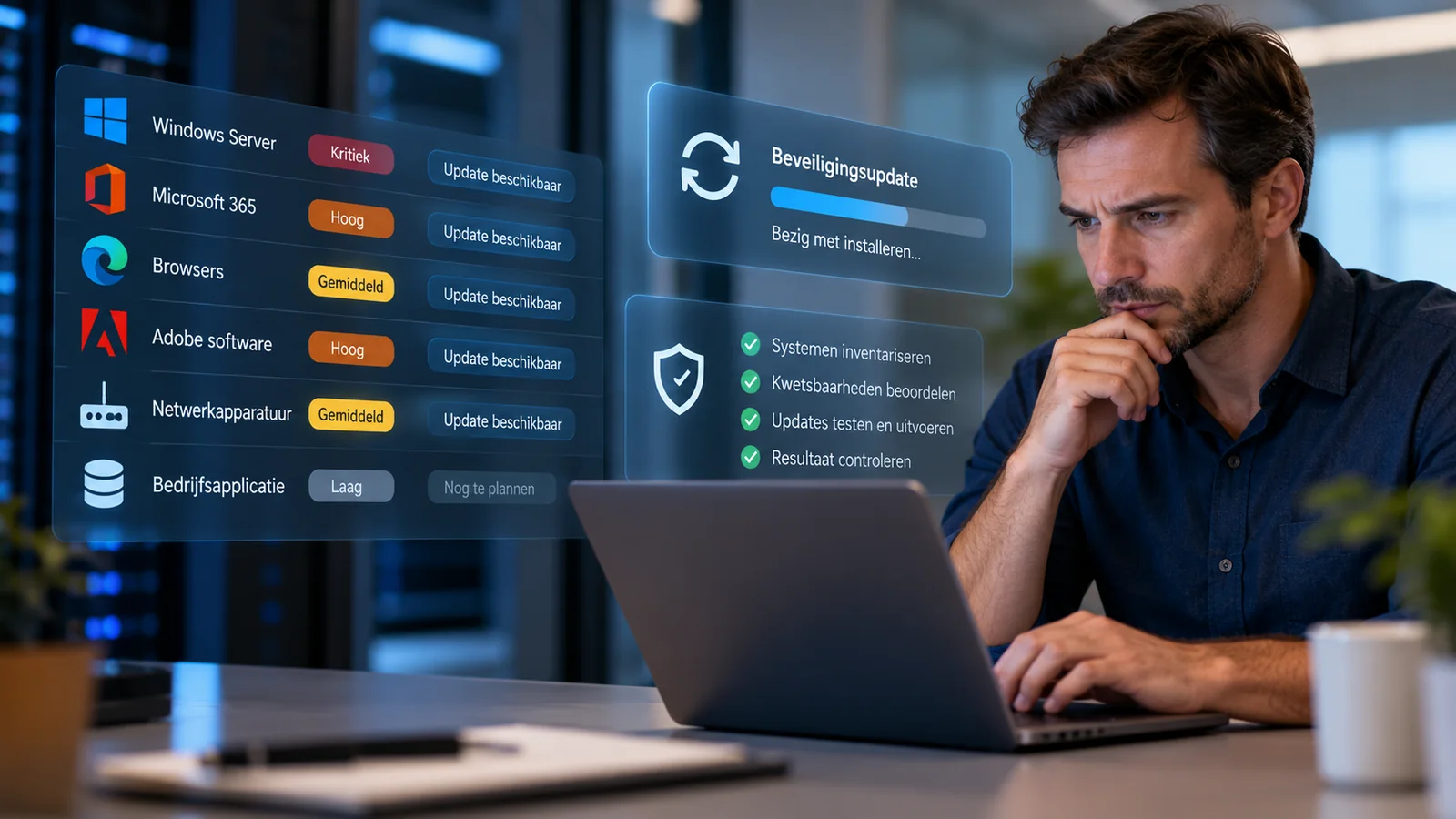
— Security updates, application changes and new software are assessed and implemented in a controlled manner.Monitoring and detection
— Suspicious behaviour and security anomalies are identified, investigated and followed up in good time.
The value of these measures lies not only in reducing security risks. They help employees keep working, information remain reliable and business processes continue without unnecessary interruptions.
Security is therefore a prerequisite for good IT management, rather than an addition to it.
IT needs to evolve with the organisation
An IT environment rarely stays the same. Employees join and leave, roles change, applications are replaced and organisations develop new ways of working. Working from home, mobile working and collaboration with external parties also continually bring changing requirements.
When IT management fails to keep pace with these changes, problems gradually arise. Access rights remain in place when they are no longer needed. New applications are introduced without their dependencies being properly examined. Devices are used outside routine management, and suppliers are given access without it being clear who is responsible.
Good IT management therefore also means translating changes within the organisation into timely changes to the IT environment.
When a new employee joins, for example, providing a workstation and an account is not enough. The right applications, security settings and access rights also need to be arranged. When an employee leaves, that access needs to be carefully revoked.
The same applies to new applications and changes to business processes. The technical configuration needs to remain aligned with the way the organisation works.
A reliable IT environment is not only configured well. It stays well configured as the organisation changes.
Coordination prevents components from working at cross purposes
In many organisations, several parties are involved in IT. One supplier provides the business application, another supports telephony, and another supplies cloud services or specialist equipment.
That need not be a problem, as long as it is clear how these services and systems relate to one another and who is responsible for the various components.
In practice, risks arise precisely at the boundaries between responsibilities. An application supplier implements an update that affects the infrastructure. A new integration is set up without adequate assessment of its security. Or several parties investigate a fault while nobody has a complete overview.
Coordination is therefore an essential part of good IT management.
This is about maintaining a coherent whole, rather than taking over all the work of other suppliers. Changes need to be coordinated, responsibilities need to be clear, and significant risks need to be assessed and addressed.
For the business owner, this means they do not have to organise the technical cooperation between suppliers themselves, but they must be able to gain insight into the risks, decisions made and any limitations.
In practice: a change with consequences for the whole organisation
A new application affects more than one system
A trading company wants to introduce a new application for processing warehouse orders. The software supplier has demonstrated its functionality, and employees are enthusiastic. From a technical perspective, implementation appears straightforward.
During preparation, however, it becomes clear that the application depends on several existing systems and services. Employees use mobile scanners, the application exchanges data with the ERP system, and access is provided through the company network. External staff also need to be able to provide support at certain times.
If the application were introduced without further coordination, problems could arise with network access, data exchange, security or the availability of existing processes.
Malenco therefore assesses, together with the supplier, how the application needs to function within the existing IT environment. This includes examining the required connections, access rights, security measures, technical dependencies and how implementation can take place in a controlled manner.
It is also decided in advance how to respond if unexpected problems arise during the launch.
The result is not only a working new application, but a change implemented in a controlled manner without unnecessary risks to existing business operations.
Illustrative practical example.
People and support make the difference
Business continuity does not depend solely on technology. The way employees use IT also determines how reliably day-to-day business operations run.
Employees need to be able to count on properly configured workstations, secure access to information and support when they encounter problems. An accessible service desk helps resolve disruptions quickly, while also providing valuable information about recurring problems.
When the same error message appears regularly, it is important to investigate the underlying cause as well as deal with the incident.
Awareness also plays an important role. Employees who recognise phishing, handle information carefully and know how to report suspicious situations help prevent incidents.
Technical security, user guidance and awareness therefore reinforce one another. An organisation becomes more reliable not only through better systems, but also through employees being able to use those systems safely and effectively.
Even good IT management has its limits
Even a carefully designed and exceptionally well-managed IT environment can be affected by a serious outage, a cyber incident or a failure at an external supplier.
Measures therefore remain necessary to limit the impact of such events. These include redundant systems and services where necessary, alternative ways of working, reliable backups, recovery procedures and clear agreements with the suppliers involved.
The appropriate measures depend on the importance of the business processes concerned. Not every system needs the same level of availability, and not every interruption has the same consequences.
The organisation therefore needs to be able to identify which processes are essential and which consequences of downtime are acceptable. It is then up to the IT provider to explain the technical options available, the risks that remain and the measures required.
Prevention, impact reduction and recovery thus form a coherent approach. Not because every disruption can be ruled out, but because the organisation needs to be as well prepared as possible.
Business continuity is the result of good IT management
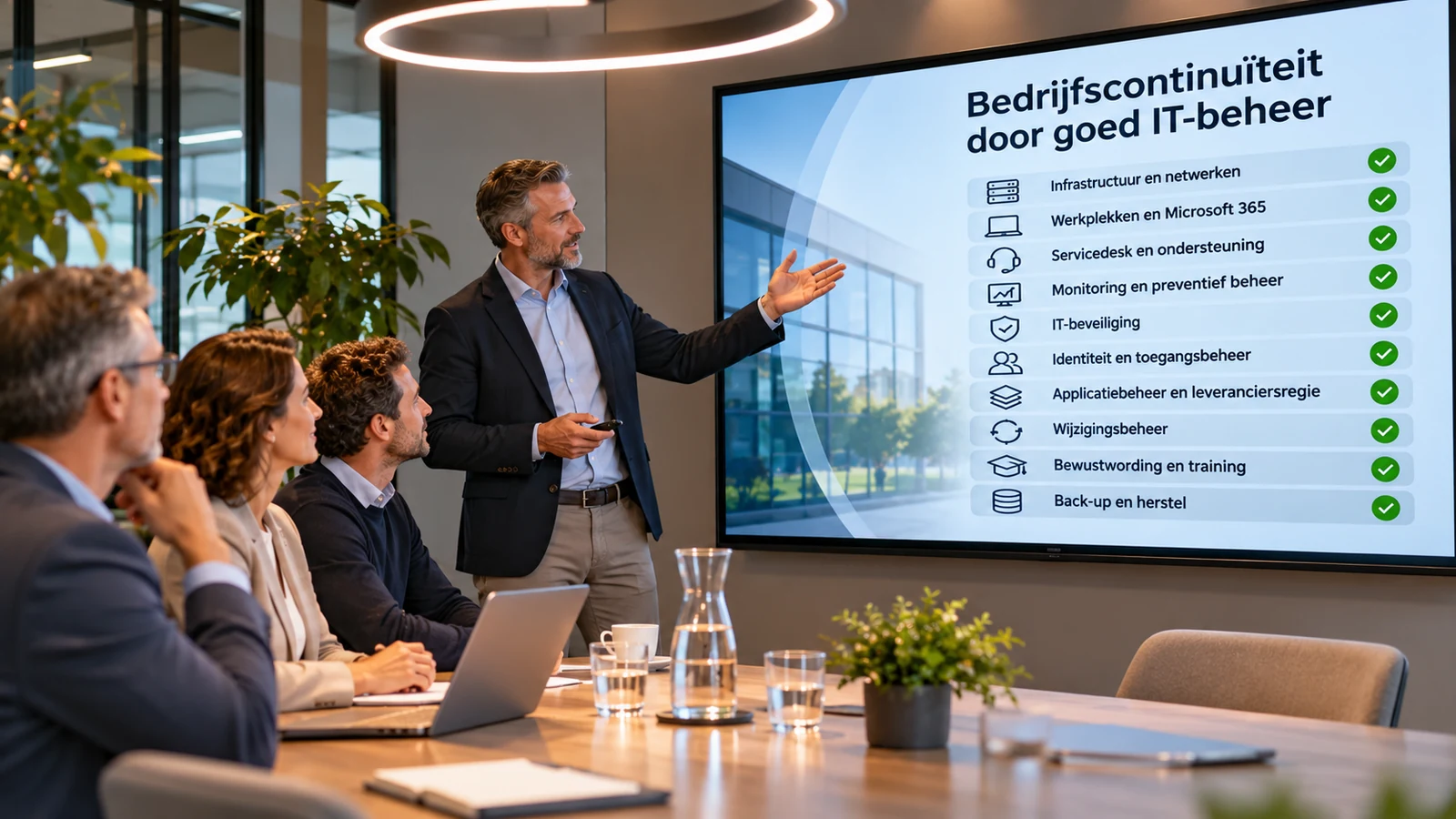
A stable network, secure workstations, reliable applications and good support are valuable in their own right. But their real significance lies in what they enable together: an organisation where employees can do their jobs and business processes continue to function reliably.
Business continuity therefore requires more than carrying out technical management tasks. It calls for ongoing attention to availability, security, changes, dependencies and the needs of the organisation.
This is also how Malenco views IT management. As a coordinated responsibility in which technology, security and business interests come together, rather than a collection of separate services.
Good IT management is no guarantee that nothing will ever go wrong. It does, however, ensure that problems are prevented as far as possible, risks remain manageable and the organisation can rely on its IT.
And that is ultimately what business continuity is all about.