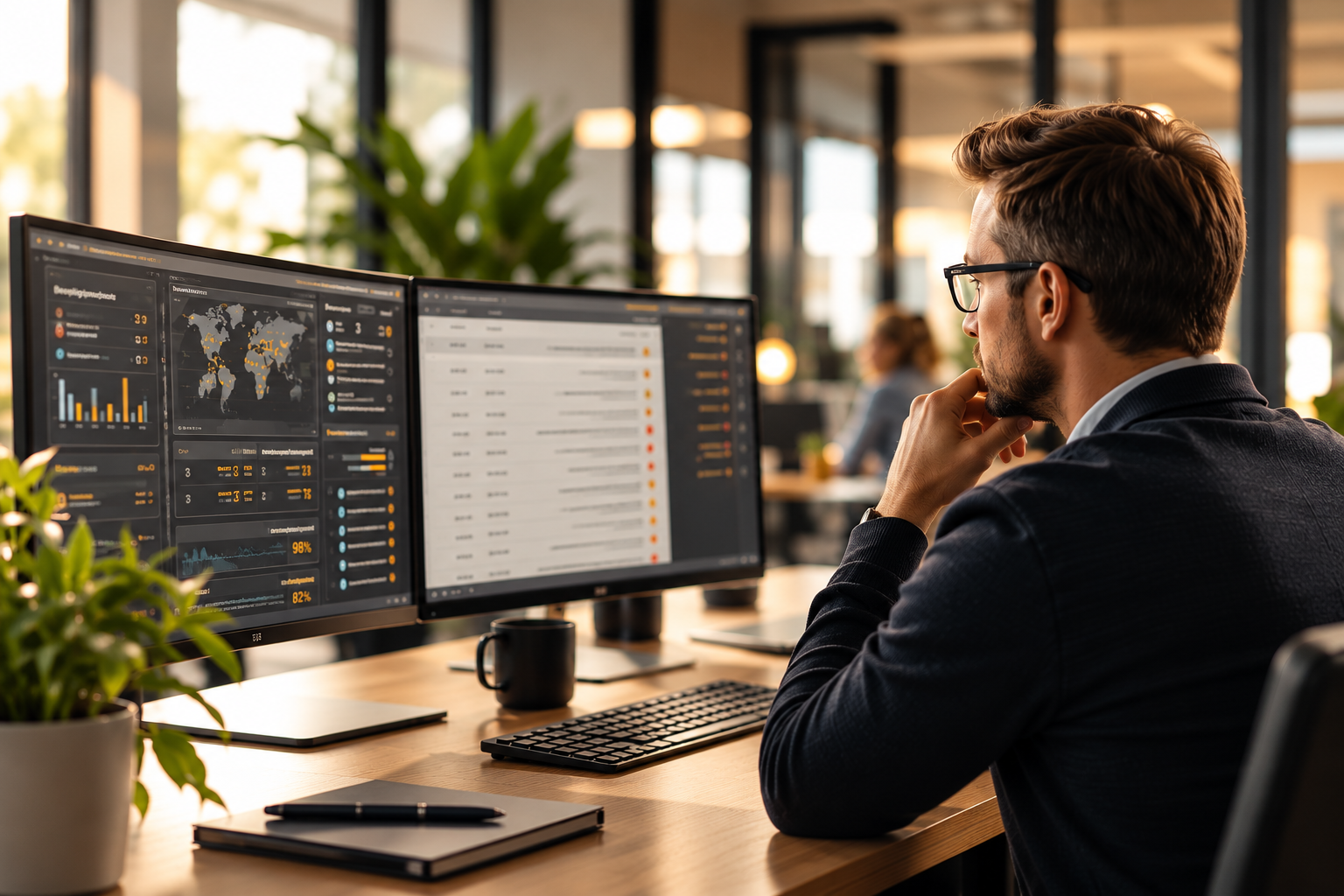
Good security starts with how your IT is managed every day.
A firewall, endpoint protection or MFA does not automatically make an IT environment secure. Security arises from the way technology, settings, access, management and monitoring work together. That is why we do not treat security as something added on top of IT management, but as the starting point for how we set up and manage your environment.

Security measures only work when they are properly configured and monitored.
Many organisations already have firewalls, antivirus, MFA and back-up in place. Yet the presence of these solutions says little about how well digital risks are actually being managed.
Settings change. New devices and applications are added. Accounts receive different permissions. Suppliers get access. Software becomes outdated. And meanwhile, events occur every day that may point to misuse, unusual behaviour or an incorrect configuration.
That is why we look not only at what has been installed, but also at what changes and what the environment is telling us.
What we secure and monitor.
We look at the entire IT environment and the way its different parts relate to each other. This results in an environment where security is part of day-to-day management.
Identity & access
Who can log in to what, with which permissions and under what conditions?
Workstations & servers
Protection against malware, ransomware and exploits, with insight into the security status of endpoints.
Network & connections
Firewalling, segmentation, VPN and control over traffic between systems, locations and the internet.
Cloud & Microsoft 365
Security settings, accounts, access and relevant signals within the cloud environment.
Vulnerabilities & configuration
Updates, configurations and known vulnerabilities can change the risk profile.
Logging, detection & follow-up
Recognising, assessing and, where necessary, following up on relevant events.
Prevent where we can. See what is happening. Respond when needed.
For us, security and monitoring form a single ongoing process, as part of day-to-day IT management.
Protect
We set up appropriate technical measures to limit known and foreseeable risks.
Monitor
We collect and monitor relevant information from the environment so that changes and security events become visible.
Assess
Not every signal is an incident. We place events in context and determine which signals require attention or action.
Respond & improve
Where possible, we intervene immediately. We use findings to further improve measures, settings and management.
An alert is not the same as security.
Modern IT environments continuously generate alerts. The challenge is not to collect as many alerts as possible, but to recognise relevant signals and respond to them appropriately.
A suspicious connection on a firewall, unusual behaviour on a workstation and an uncommon login may individually say little. Together, they can give a very different picture.
That is why, where possible, we look across individual security layers. This creates context and makes it possible to determine more quickly whether an event is normal behaviour, a technical issue or a possible security incident.
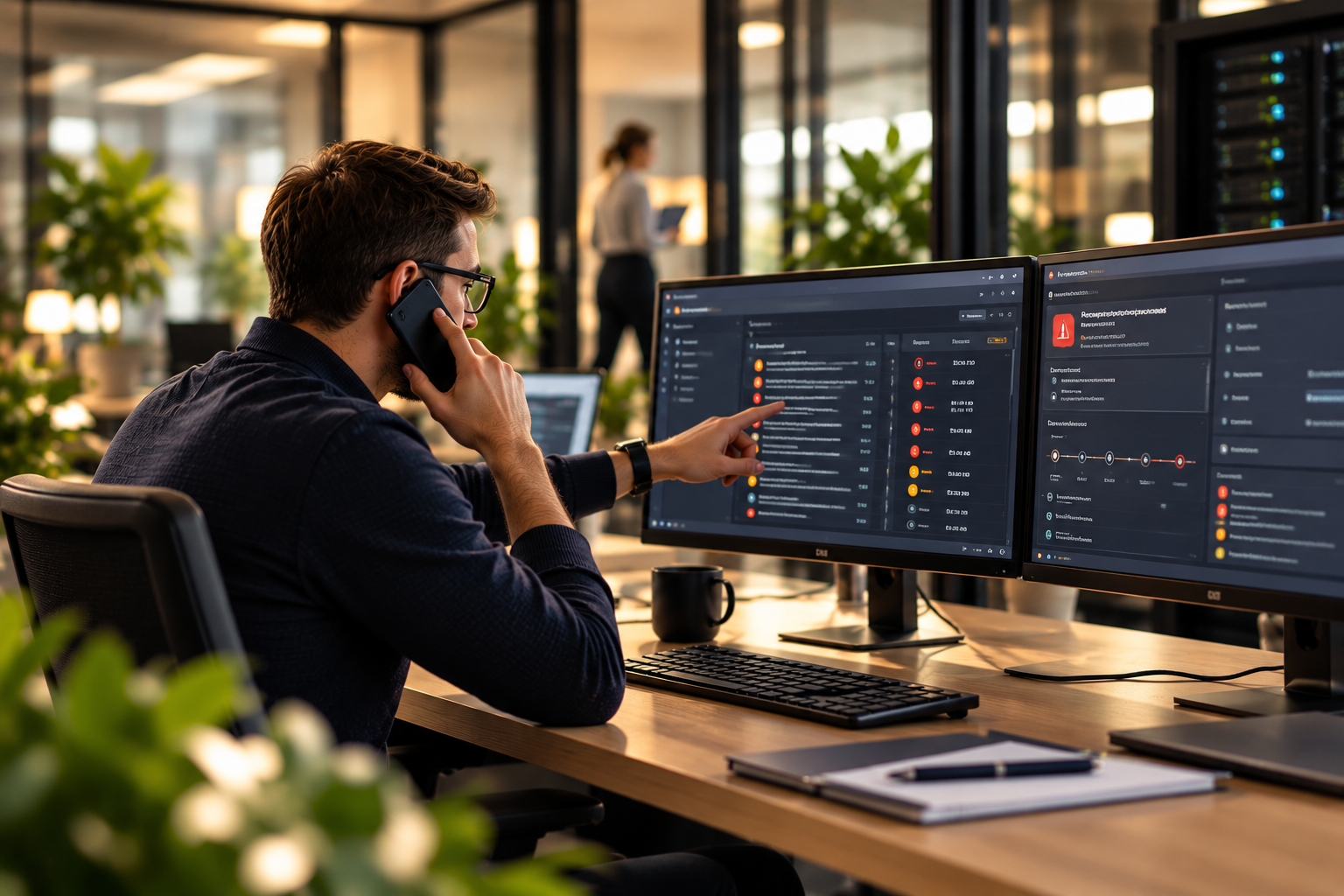
Examples from daily practice.
An employee opens a malicious file.
Endpoint protection signals unusual behaviour. It is not just about blocking, but also about the context and any activity elsewhere in the environment.
A supplier connects to your network.
The connection may be technically legitimate, but who gets access, to which systems, for how long, and is that access logged?
An account logs in unusually.
A successful login does not automatically mean the right person is logging in. Location, device, permissions and other behaviour can be reason to look further.
Detection only has value when it is clear what happens next.
A security signal can call for different actions: further investigation, blocking a connection, isolating a device, adjusting access, or contacting a user or responsible person.
That is why monitoring also requires clarity about follow-up, escalation and responsibility.
Not every incident can be handled fully automatically. Where automated measures are appropriate, they can greatly shorten response time. Where assessment is needed, it must be clear who decides and what the appropriate next step is.
Security doesn't stop at monitoring
Within IT Management, we secure and monitor your environment as part of day-to-day management. When the question goes beyond day-to-day management, specialist investigation may be needed.
IT Management
Securing, monitoring, signalling and following up.
Protection
Investigating, analysing, assessing and reviewing.
Are the relevant digital risks actually sufficiently under control?
Discover Malenco ProtectionWant to know more about specific topics?
Depending on your situation, we can go deeper into various topics.
Endpoint protection & EDR/XDR
How workstations and servers are protected and monitored against malicious activity.
Read the articleIdentity & access security
How identities, permissions and authentication contribute to a manageable environment.
Read the articleSecurity monitoring & detection
What is monitored and how relevant signals are recognised.
Read the articleVulnerabilities & patch management
How updates and configurations affect the risk profile of the environment.
Read the articleIncident detection & response
How signals are assessed and followed up when an incident is suspected.
Read the articleDo you know what is being monitored in your IT environment — and what happens when something deviates?
We would be glad to discuss how security, monitoring and day-to-day management are organised within your current environment.
Discuss your current IT management