A network outage often only becomes apparent when employees can no longer access applications, a production machine stops communicating or a branch becomes unreachable. Yet many problems do not arise overnight. A connection comes under increasing load, a switch records a growing number of errors or a redundant connection fails unnoticed. The network continues to function for the time being, but its reliability declines.
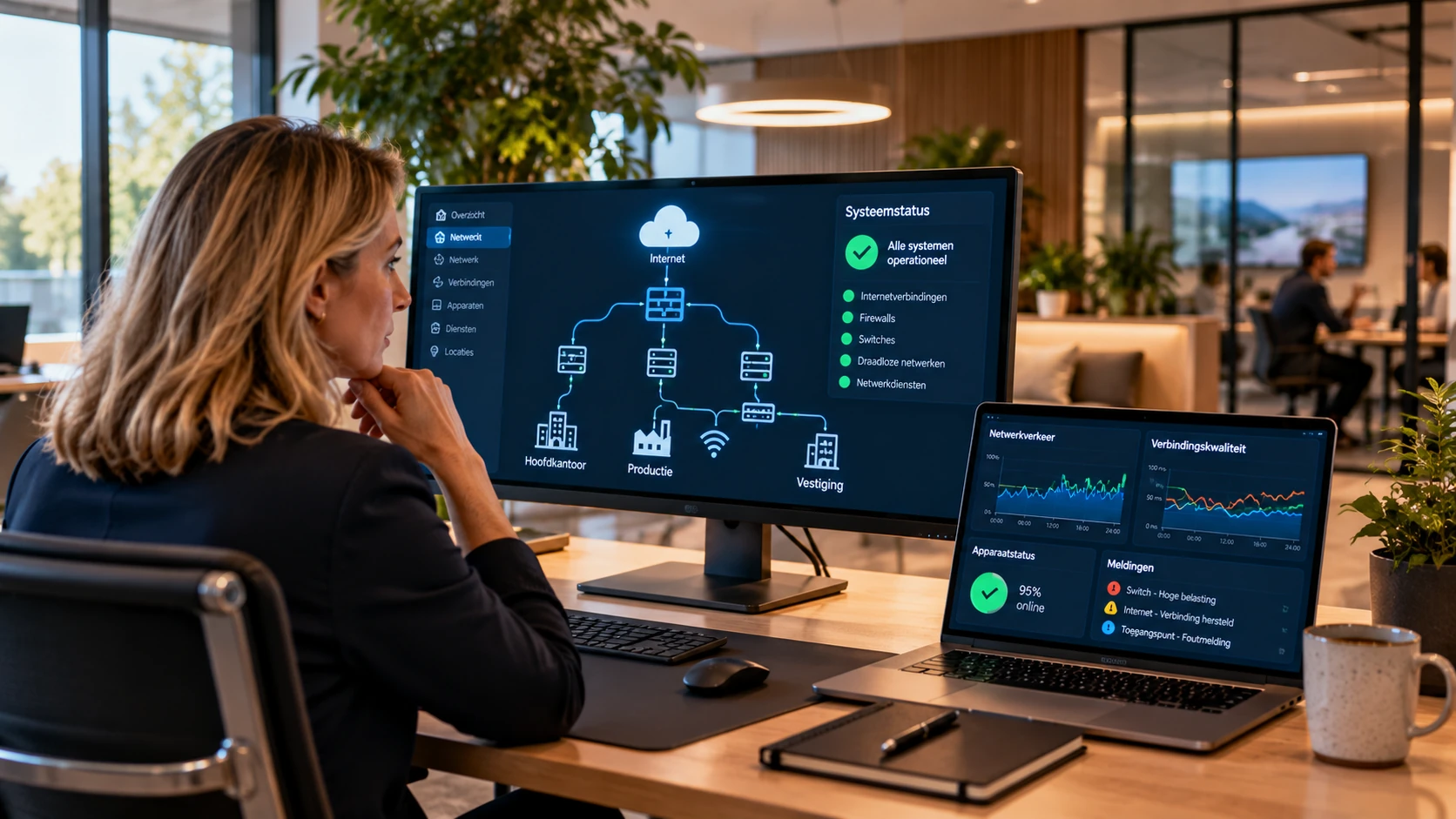
Network monitoring makes these developments visible before they lead to major disruptions. By monitoring the availability, performance and technical condition of the infrastructure, deviations can be identified earlier and problems investigated more precisely. This involves more than collecting measurements: above all, it means understanding what those measurements mean for business operations.
A working network is not automatically a healthy network
When employees can work without problems, the network appears to be functioning well. But the absence of complaints says little about the technical condition of the infrastructure. A connection may be approaching its maximum capacity without users noticing immediately. A switch may be recording errors while traffic is still being processed. And if one of two redundant internet connections fails, the organisation may remain online as usual, even though the backup connection is no longer available.
Monitoring must therefore go beyond checking whether equipment is reachable. Connection quality, the load on network components and the operation of redundant infrastructure also deserve attention. Tracking this information over time also reveals whether a deviation is an isolated occurrence or part of an ongoing trend.
What does network monitoring cover?
A company network consists of various components that together enable communication between employees, applications, servers, cloud services and production systems. To assess how they are functioning, monitoring typically covers four areas.
Network equipment
— The availability, load and technical condition of switches, routers, firewalls and other network components.Connections
— Bandwidth usage, latency, packet loss, connection interruptions and the operation of redundant routes.Wireless networks
— The reachability, connection quality and load of wireless access points.Network services
— The operation of essential functions such as DNS, DHCP and routing, which are needed to keep systems and applications reachable.
Which components need extra attention depends on the organisation. An office environment using mainly cloud applications has different dependencies from a manufacturing company with machines, industrial control systems and connections between several buildings. Effective monitoring therefore reflects the network's design and the importance of the business processes connected to it.
From measurements to actionable alerts
Network equipment can provide large amounts of technical information. But collecting data does not, in itself, constitute effective monitoring. The information must be assessed and translated into alerts that can actually be acted upon.
A connection that has failed completely is relatively easy to identify. It becomes more difficult when a connection still works but increasingly suffers packet loss or lacks sufficient capacity at certain times. Such problems require an understanding of normal usage and thresholds that suit the environment concerned.
At the same time, every temporary deviation should not immediately trigger an alarm. If a monitoring system sends a notification for every load spike, it soon generates a large volume of alerts that add little value. Effective monitoring therefore distinguishes between situations requiring immediate action and developments that warrant further investigation or periodic review.
Network monitoring and security monitoring: the same network, a different purpose
Network monitoring and security monitoring sometimes use the same technical information, but assess it from different perspectives.
Network monitoring
Purpose: to monitor availability and performance.
Network monitoring focuses on the technical operation of the infrastructure. Are devices and connections available? Are network services functioning correctly? Are delays, errors or capacity problems emerging that could disrupt business operations?
An unexpected increase in network traffic may, for example, prompt an investigation into the load on a connection or the operation of an application.
Security monitoring
Purpose: to identify potential security incidents.
Security monitoring examines signals that may indicate misuse, unauthorised access or other security incidents. It considers not only the volume of traffic, but also the systems involved, the communication that is permitted and additional security information.
The same unexpected increase in network traffic may prompt an investigation into whether systems are communicating with one another in an unintended way or sending data to an unknown destination.
The two forms of monitoring complement one another. A technical problem can have security implications, while a security incident can affect network availability. An unusual traffic pattern, however, is not automatically a security incident. It may also be caused by a new application, a backup process or a configuration change. Identifying a deviation is therefore the beginning of an assessment, not its conclusion.
Monitoring must reflect the network architecture
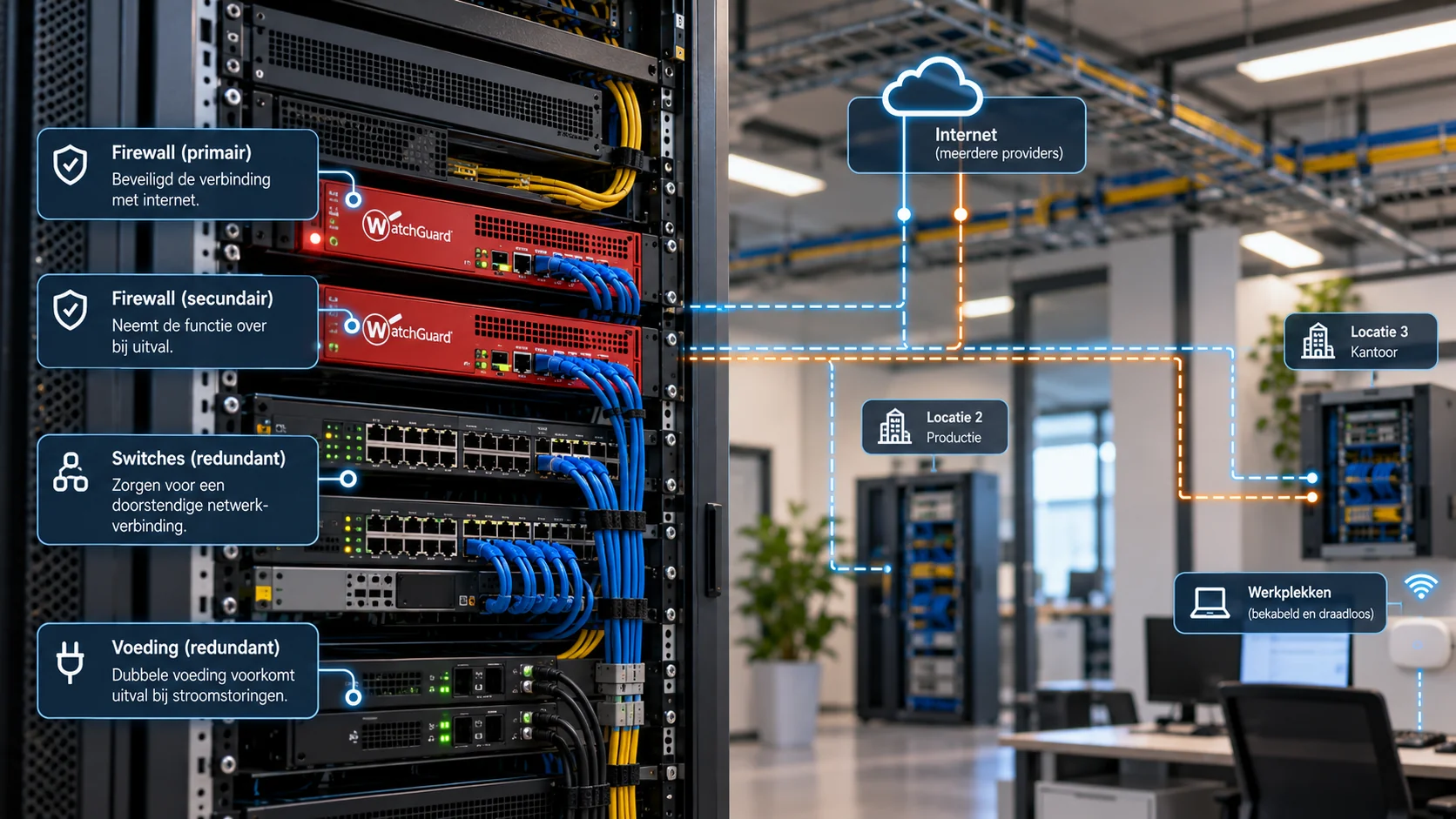
Not every network component is equally important for continuity. A fault in an individual wireless access point may have limited consequences if other access points take over its coverage. The failure of a central switch, firewall or connection between buildings, however, can affect large parts of the organisation.
Monitoring must therefore be designed around the network architecture. This means considering critical connections, shared dependencies, redundant infrastructure and the systems required for business processes. Where a connection is redundant, for example, monitoring should check not only whether the overall connection remains available, but also whether both individual routes are still functioning.
Network segmentation also plays a role here. In a segmented network, communication paths are deliberately restricted. When investigating a connection problem, it is therefore necessary to distinguish between a technical fault and communication that is correctly being blocked under the security rules.
From notification to action
A monitoring system can automatically detect that equipment is unreachable or that a connection is behaving unusually. But a notification only has value when it is clear what should happen next. Four steps are important here.
Detect
— Monitoring identifies a fault, deviation or development that requires attention.Assess
— Severity is determined on the basis of the technical situation and the potential consequences for business processes.Investigate and restore
— The cause is established and the necessary measures are carried out.Evaluate
— An assessment determines whether the problem can be prevented on a lasting basis and whether monitoring needs to be adjusted.
Not every notification requires the same speed of response. A business-critical connection may require immediate follow-up, including outside office hours. A gradual increase in the load on a less important network component can be investigated during a periodic review.
It also helps when notifications contain sufficient context. A message saying that a network port is unreachable means little on its own. Knowing which systems are connected through that port and which business processes depend on them makes it much quicker to assess the impact.
Monitoring also helps improve the network
The information monitoring provides is useful beyond dealing with faults. Analysing performance and deviations over time reveals where the infrastructure is under sustained pressure or where improvements are possible. A connection that regularly experiences heavy load at particular times may warrant a capacity review. Recurring errors on a network port may indicate problems with cabling or equipment. And if a redundant connection repeatedly drops, the reliability of that connection deserves further investigation.
Changes within the organisation can also affect the network. New applications, additional workstations, production equipment or cloud connections change how the infrastructure is used. Monitoring makes it possible to track these developments and base adjustments on actual usage rather than solely on assumptions.
Network visibility is part of responsible IT management
A reliable network requires not only good equipment and a carefully considered design, but also continuous insight into how it is operating. Without monitoring, problems often only become visible when employees experience disruption, even though technical signals may have indicated earlier that a component was no longer functioning as intended.
Network monitoring helps identify deviations in good time, investigate faults more precisely and assess the technical condition of the infrastructure on an ongoing basis. This requires measurements to be linked to knowledge of the network architecture, business processes and responsibilities within IT management.
The aim is not to collect as many notifications as possible, but to know in good time when the infrastructure needs attention — and to ensure that those signals are actually followed up.